

Sister school in Mexico (JdlB) teaches JSIS how to make one of Jalisco's traditional articraft : Ojos de Dios
Today, we were supposed to have a conference and English lesson with the school Vera Cruz.

Because of the heavy rain, the school has been out of electricity for 3 days. The teachers have been told that it will be repaired by Sunday.
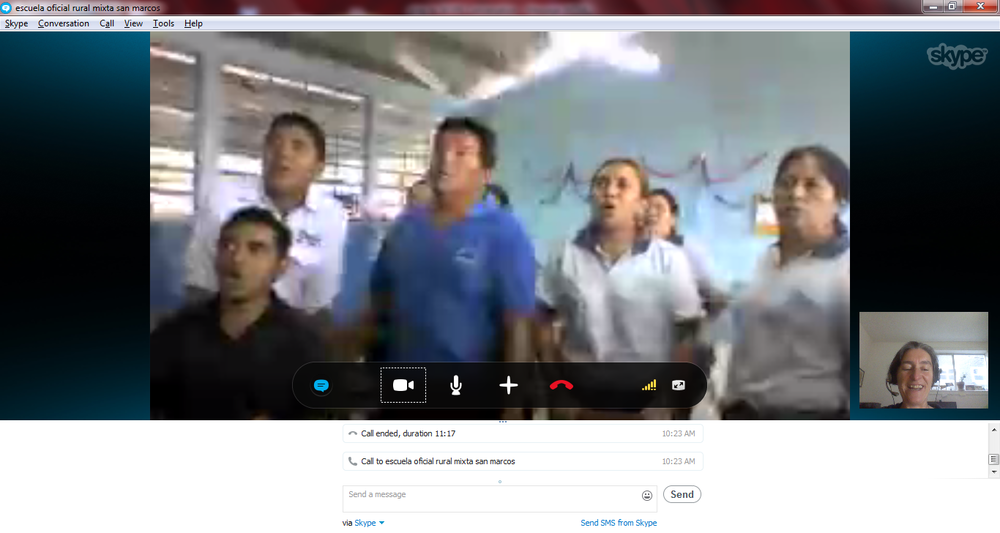
Today, through SKYPE, I joined virtually a 3rd grade class, with Maestra Marlene. The subject of the lesson was the digestive system.

Marlene had plugged in the computer, the projector and the screen. She showed a short educational video of the digestive system to her students. She paused the video several times to ask the students questions. At the end of the video, she projected a large colorful image of a human body, and called various students to point out to the different organs.

The children were attentive and engaged (although a little distracted by my virtual presence).
Marlene could clearly show that after few months of training and support, she had mastered connecting the equipment, searching and selecting appropriate material, and incorporating it all to create an engaging class. It was impressive.
As a cherry on the cake, the students had practiced a “mother’s day song” that they wanted to perform. It was Karaoke style, with the words projected on the screen.
Here is a very simple one minute video of this exchange : http://www.tinfa.org/tyfyd/
Corcho del sur has created its own blog, with few pictures of the school. Take a look, and don't hesitate to live a comment.
This week, we have our monthly Skype training and discussion with each of the three pilot schools in the Xela region of Guatemala. We have had 2 of our 3 meetings so far.
These teachers are so willing to learn and are making such fast progress, it is really impressive!

Each of the 3 schools now has a blog, with nice pictures of their schools, and their first impression of being connected. Here they are:
Feel free to post a comment. I can insure you that the amount of gratefulness that you will receive will vastly surpass the little time you will spend on writing it.
We are spending the first part of our interaction on a "flipped classroom training". The teachers review the first 3 lessons of English Anyone prior to our meeting (singular/plural, exceptions, adjectives and colors). During our interaction, we practice, and I answer questions related to the lessons. I am told by the teachers that one of the challenge is pronunciation. As many of you can tell, I might not be the right person to tackle that challenge. The videos will help though.
We talk about the appropriateness of this flipped classroom and specific video training format, as the teachers work with their students.
For the second part of our interaction, we talk about the use of the equipment and specific applications. There, I have to recognize the great work of our local partner organization, FUNDAP. The staff at FUNDAP has been able to create such a level of trust over the years with the community, that there is an enormous openness and honesty underlying the conversations with the teachers.
For example, even though we have met only through Skype, and we know very little of each other, it is possible to ask tough questions like "who is currently not using the equipment?". It is a potentially threatening question. Yet, people step forward and are willing to take a risk. One teacher raises his hand, takes the microphone and says "I have not yet".
The next major risk is that we get into a disempowering conversation, with a possible underlying attitude of passive assistance. This is not AT ALL the case. We are having a concrete, detailed discussion, with the teachers taking full responsibility for their learning. I believe that this amazingly positive attitude has been nurtured by our local partner FUNDAP, and the amazing teachers we are working with.
So grateful. More on the content of the discussions later...
In order to participate in our skype conversation, the teachers of Canto Veracruz had to move a block outside of the school, to get a better signal. (Yes, a talk with the provider, Claro, is in order). That's why the teachers are sitting on the ground outside, rather than in a classroom.

Through sharing screen, we located the area of the school, and we learn that it would take 1,160h to walk from Veracruz to Seattle.
100% of the parents and 50% of the students at Canton Veracruz speak Mayan. We talked about the difficulty to find material that is pertinant to the language and the culture. The idea came up that it might be possible for the students, with the help of the Maya language teacher and the teacher of Expression artistica to create one or several small videos, where the students would be able to show some of their learning of their culture. This video could then be share with other schools in the region that are of Mayan ethnic and culture. Students as teachers, and creating lacking material for the students to understand their roots and culture... this sounds right!
La escuela Veracruz has already created a
, and the entry of March 1st talks about TINFA. Sweet!
Tomorow they are inaugurating a new building, a classroom where they will have the technology kit.
After talking to all 3 schools, it feels like we have a nice way forward. We are going to use the vocabulary and grammar of lessons 1 to 3 of
to practice. Yes, yes, it is right. We are talking about flipped classrooms, where the teachers will watch and study, and we will use the "class"/skype time to practice. This sounds right too!